
Tentempietto o Sueño con capitolios
Los días romanos de Claudio Sotolongo han sido perseguidos por un carcelero mudo e incoercible: justo en el centro del patio, el “Tempietto del Bramante” se encuentra en pleno control del espacio, mirando dentro de cada ventana de la Real Academia de España. De forma bastante inesperada nos damos cuenta de que se mueve lentamente, aunque implacablemente alrededor de su eje.
¿Era una necesidad? ¿Fue por el virus?
Algo recuerda al Panopticon, el dispositivo perfecto para disciplinar y, según Michel Foucault, el modelo y figura del poder en la sociedad moderna. De esta manera, el Tempietto encarna la determinación de vigilar y controlar, a todos y a cada uno, permaneciendo invisible, completamente oculto en si mismo, como el ojo vacío de una estatua de mármol.
Sin duda Bramante había pensado en un centro, un nuevo Panteón para la Cristiandad, circular y autónomo, en espera y como prototipo más pequeño de la próxima Basílica de San Pedro.
Y, tal vez más importante que el sitio del entierro en si mismo, el Tempietto se suponía que se quedaría donde el acto mismo había sucedido, donde se realizó el martirio y la cruz de San Pedro fue fijada en el suelo, al revés, preparando el escenario para un drama inminente.
De esta manera se estableció un centro, como con un poste topográfico y dieciséis columnas, alrededor del edificio, para apuntar, como en una brújula de piedra y en todas las direcciones, hacia el mundo entero.
Esto podría haber sido el comienzo de una cartografía, y esto fue todo para Claudio Sotolongo, en un proceso diario de salir a patrullar la ciudad y volver al Claustro.
Había sido un paciente estudio de los lugares donde se realizan innumerables intentos de rebelión, a veces con cautela, a veces desafiantes, como pequeños incendios que se extienden por todo el mapa: acciones con las que los sujetos intentan romper la continuidad de una predeterminada red de significación.
The Roman days of Claudio Sotolongo have been haunted by a mute and incoercible jailer: right in the center of the courtyard, the “Tempietto of Bramante” stands in full control of the space, staring inside each window of the Academia de Espaňa. Quite unexpectedly we realize that it is slowly, though implacably moving around its axis.
Was it a necessity? Was it for the virus?
Something reminds the Panopticon, the perfect device to discipline and, according to Michel Foucault, the very model and figure of power in modern society.
In this way the Tempietto embodies the determination to watch and control, allover and everybody, remaining unseen, completely concealed in itself, like the empty eye of a marble statue.
Undoubtedly Bramante had thought to a center, a round and self-contained new Pantheon for the Christianity, on hold and as a smaller prototype of the upcoming St. Peter’s Basilica.
And, maybe more important than the burial itself, the Tempietto was supposed to stay where the very act had happened, where the martyrdom was performed and the cross of St. Peter was fixed in the ground upside down, setting a stage for an impending drama.
In this way a center was established, as with a topographical pole and sixteen columns, all around the building, to point, like in a stone compass, in all directions towards the entire world,
This indeed could have been the beginning of a cartography, and this was it for Claudio Sotolongo, in a daily process of going out on patrol to the City and coming back to the Cloister.
It had been a patient survey of the places where countless attempts to rebellion are performed, sometimes cautiously, sometimes defiantly, as little fires spread over the map: actions by which the subjects try to break the continuity of a given web of significance.
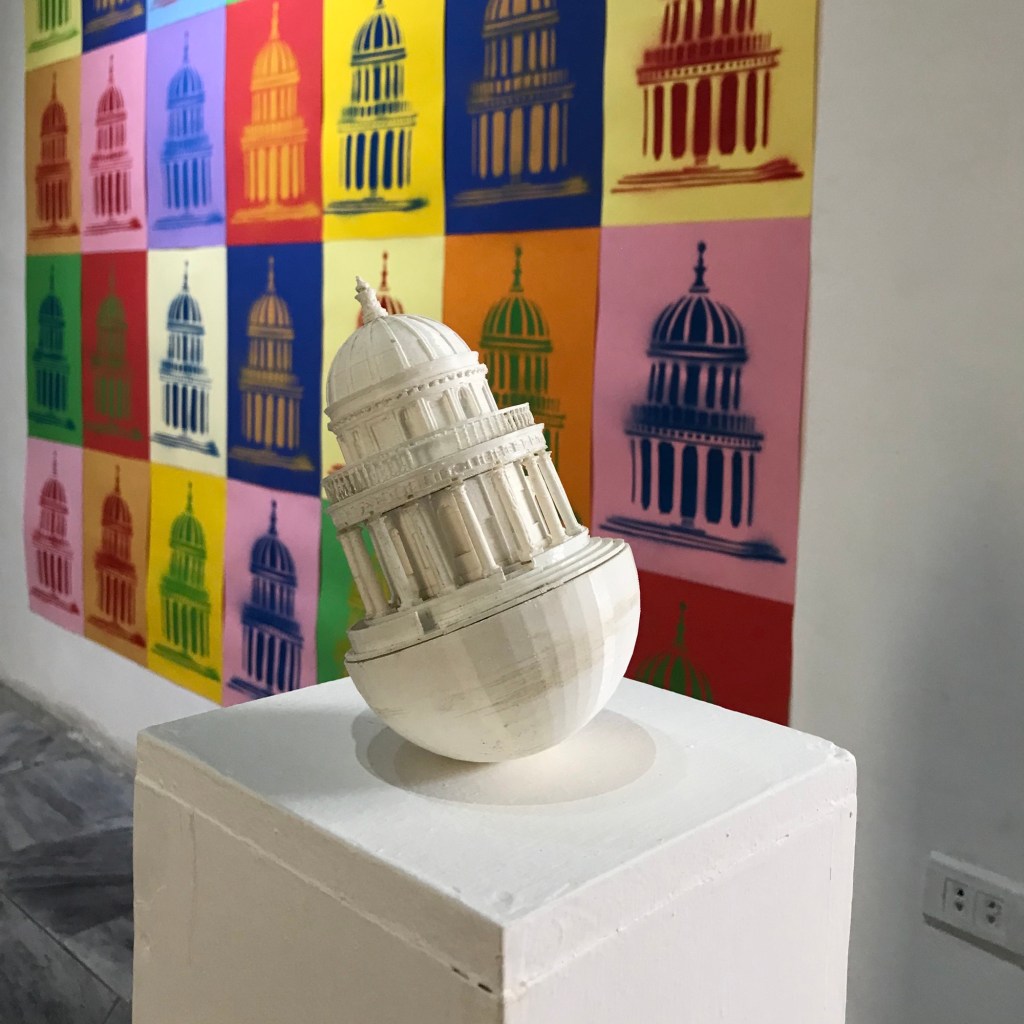
En una especie de guerrilla sutil, los significados se cambian y se distorsionan y a menudo de manera suspicaz las señales se desfiguran o incluso se borran; se trata de la creación de un nuevo vocabulario, abierto a todo el mundo para que lo utilice y lo modifique libremente, como lo fue el léxico del pop-art en los años sesenta.
Aquí se ponen en juego dos estrategias opuestas, en un extraño juego de ajedrez donde todos los peones están en guerra con el propio tablero. Una situación absurda y contradictoria, ya que los peones aparentemente pueden moverse a su antojo, pero en realidad tienen necesariamente que jugar en la cuadrícula, mientras que la cuadrícula pretende ser neutral, transparente y vacía, pero en realidad necesita una inescrutable torre de vigilancia, escondida en algún lugar, un peso arbitrario como unidad de medida, un polo de referencia para otorgar la racionalidad al orden.
Sotolongo ha experimentado esta oposición por ambos lados, actuando alternativamente como el cartógrafo y el vándalo, y su encuesta se ha convertido en su obra de arte, su poema visual.
Como científico ha investigado escrupulosamente el simbolismo del Tempietto y como relojero ha desmontado las partes internas de su mecanismo, hasta encontrar, bajo la piel de la obra maestra del Renacimiento, la máquina de soltero que es su naturaleza oculta.
En una especie de sueño duchampiano, podríamos imaginar la cripta en el sótano trabajando como un pistón extendiéndose hacia el centro del globo y la cúpula sirviendo como mando de control, graduado por las columnas y girado desde arriba por un operador invisible.
Según una metáfora posmoderna, el Tempietto irradia un flujo de deseo insatisfecho, como uno de los solteros del “Grand Verre”, sin novias alrededor, encarnando una autosuficiencia fálica que es el símbolo mismo del poder tradicional.
In a sort of subtle guerrilla, the meanings are changed and distorted and often brilliantly the signals are disfigured or even erased: it’s the bottom-up creation of a new vocabulary, open to everybody to freely use and modify, as it was for the pop-art lexicon in the sixties.
Here two opposite strategies are put in field, in a strange chess game where all the pawns are in war with the chessboard itself. A preposterous and contradictory situation, since the pawns apparently can move as they like but in truth they have necessarily to play on the grid, while the grid claims to be neutral, transparent and empty, but in fact it needs an inscrutable watch tower, hidden somewhere, an arbitrary weight as unit of measure, a reference pole to grant the rationality of the order.
Sotolongo has made experience with this opposition from both sides, acting alternatively as the Cartographer and the Vandal, and his survey has become his work of art, his visual poem.
As a scientist he has scrupulously investigated the symbolism of the Tempietto and as a clockmaker he has disassembled the inner parts of its mechanism, until he has found, under the skin of the Renaissance masterpiece, the bachelor machine which is its hidden nature.
In a sort of Duchampian dream, we could imagine the crypt in the basement working underneath as a piston, sprawling towards the center of the globe and the dome serving as a control knob, graduated by the columns, turned from up above by an unknown operator.
According to a post-modern metaphor, the Tempietto irradiates a flow of unfulfilled desire, just like one of the bachelors in the “Grand Verre”, with no brides around, embodying a phallic self-sufficiency which is the very symbol of traditional power itself.

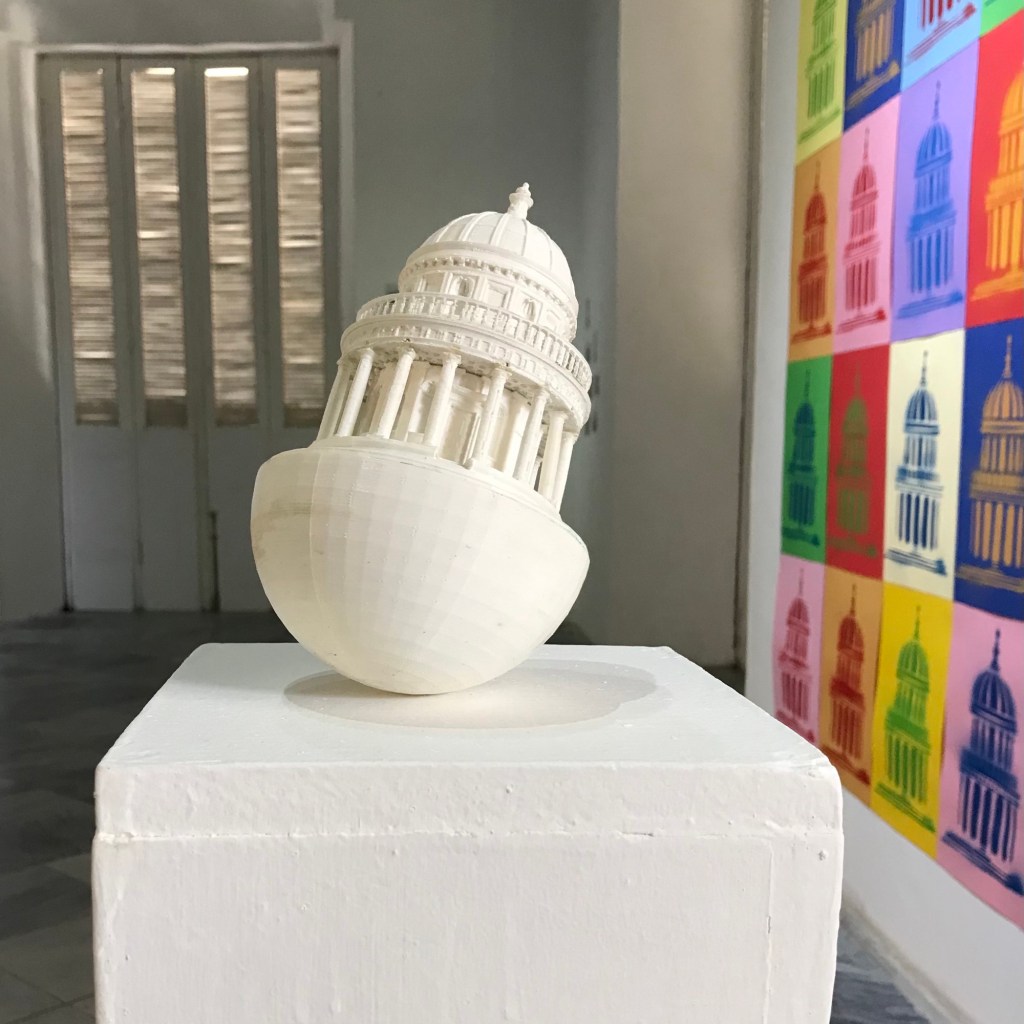
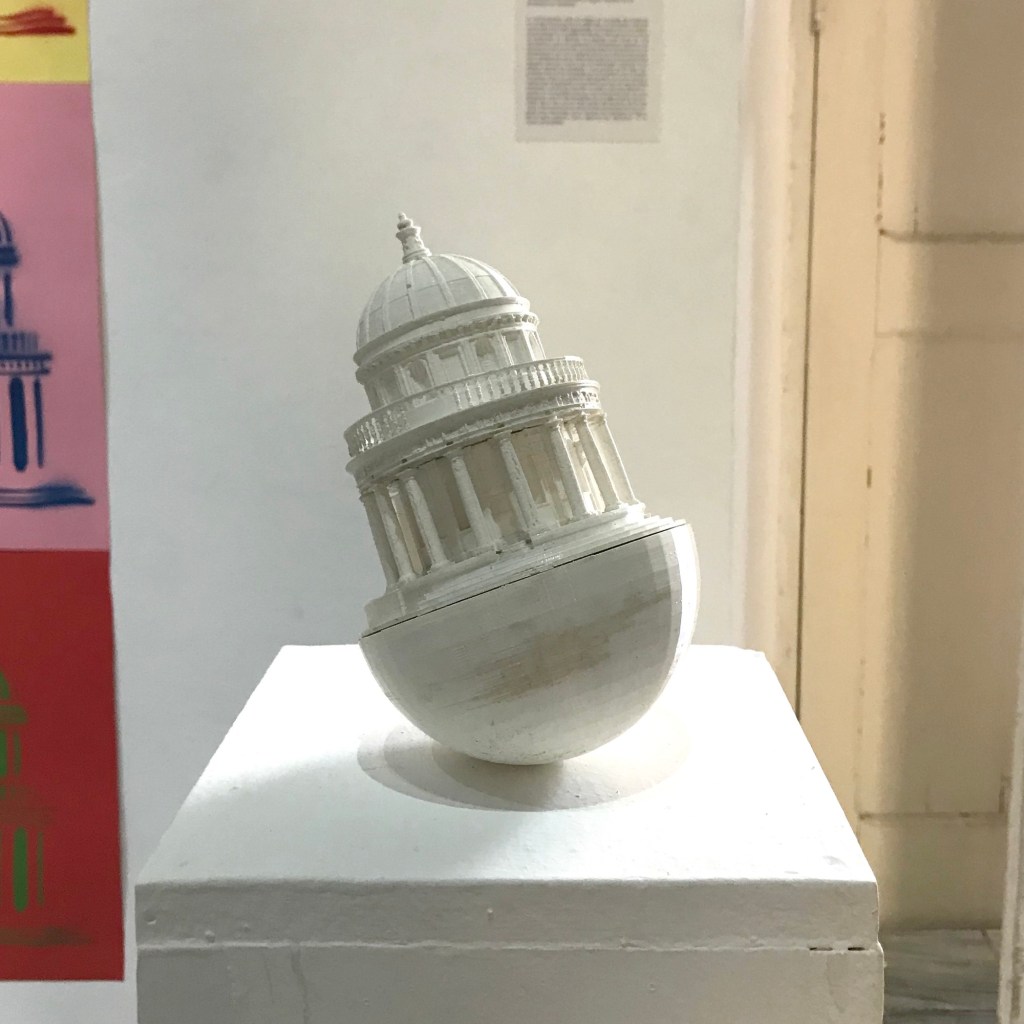
Para capturar este aspecto oculto, Claudio Sotolongo transforma irónicamente el clásico y destacado monumento en un extraño objeto, blanco como la nieve: que de repente aparece como un divertido juguete de polietileno, una marioneta de base redonda inclinable, con una pretensión de pureza inmaculada. En vano se intenta derribarlo, porque siempre es capaz de levantarse, una y otra vez, en su obstinada y obscena dureza, en un movimiento que es a la vez que inútil, implacable.
Entonces, si dirigimos la atención a la Ciudad, tenemos una visión de la escena donde el poder realiza sus manipulaciones sutiles y sus evidentes represiones. No siempre encontramos necesariamente un gueto, pero constantemente tenemos que permanecer dentro del marco arquitectónico donde un sistema utiliza sus figuras retóricas, por medio de su equipo visual y, en respuesta, los individuos ponen en marcha su contraataque personal, su propia narrativa.
De nuevo, como con el tentempié, es un movimiento pendular, partida y retorno.
Parece un impulso simétrico, un flujo libidinoso de agresividad y deseo viciado, pero al mismo tiempo es un esfuerzo poético que constitucionalmente necesita contener un componente destructivo.
Vándalos porque son poetas visuales, poetas visuales porque son vándalos.
Vemos una abrumadora producción de signos que se exhiben en los espacios públicos: fragmentos de desfigurados objetos utilitarios, de carteles, de detalles arquitectónicos, de monumentos, de marcas comerciales.
La subversión se lleva a cabo arrancando la publicidad y las imágenes, escribiendo firmas y dibujando grafitis, dentro de un rehilete de dispersados fragmentos de sentidos y de nuevo, a través de la mise en scène de Duchamp, entendemos que la novia desnuda es la propia ciudad.
In order to capture this hidden aspect, Claudio Sotolongo ironically transforms the classic, outstanding monument in a strange, snow white, little object: out of the blue it appears as a funny roly-poly toy, a tilting round bottomed puppet, with a pretence of immaculate purity.
In vain you try to knock it down, because it’s always able to get up, again and again, in its stubborn obscene hard on, in a movement which is both futile and relentless.
Then if we turn attention to the City, we have a glimpse of the scene where power enacts its subdued manipulations and evident repressions.
Not always we necessarily find a ghetto, but steadily we have to stay inside the architectural framework where a system uses its rhetorical figures, by means of its visual equipment and, in response, the individuals put in place their personal counterattack, their own narrative.
Again, as with the roly-poly puppet, it’s a pendular movement, partida y retorno.
It looks like a symmetrical impulse, a libidic flow of aggressivity and fouling desire, but at the same time it’s a poetical effort that constitutively needs to contain a destructive component.
Vandals because visual poets, visual poets because vandals.
We see an overwhelming production of signs that is put in full display in public spaces: shreds of disfigured utilitarian objects, posters, architectural details, monuments, brands.
The subversion is enacted ripping away advertising and pictures, putting signatures with tags and graffitis, in a pinwheel of shards of sense scattered around and again, through the mise en scène of Duchamp, we understand that the bride stripped bare is the City itself.
 Claudio Sotolongo